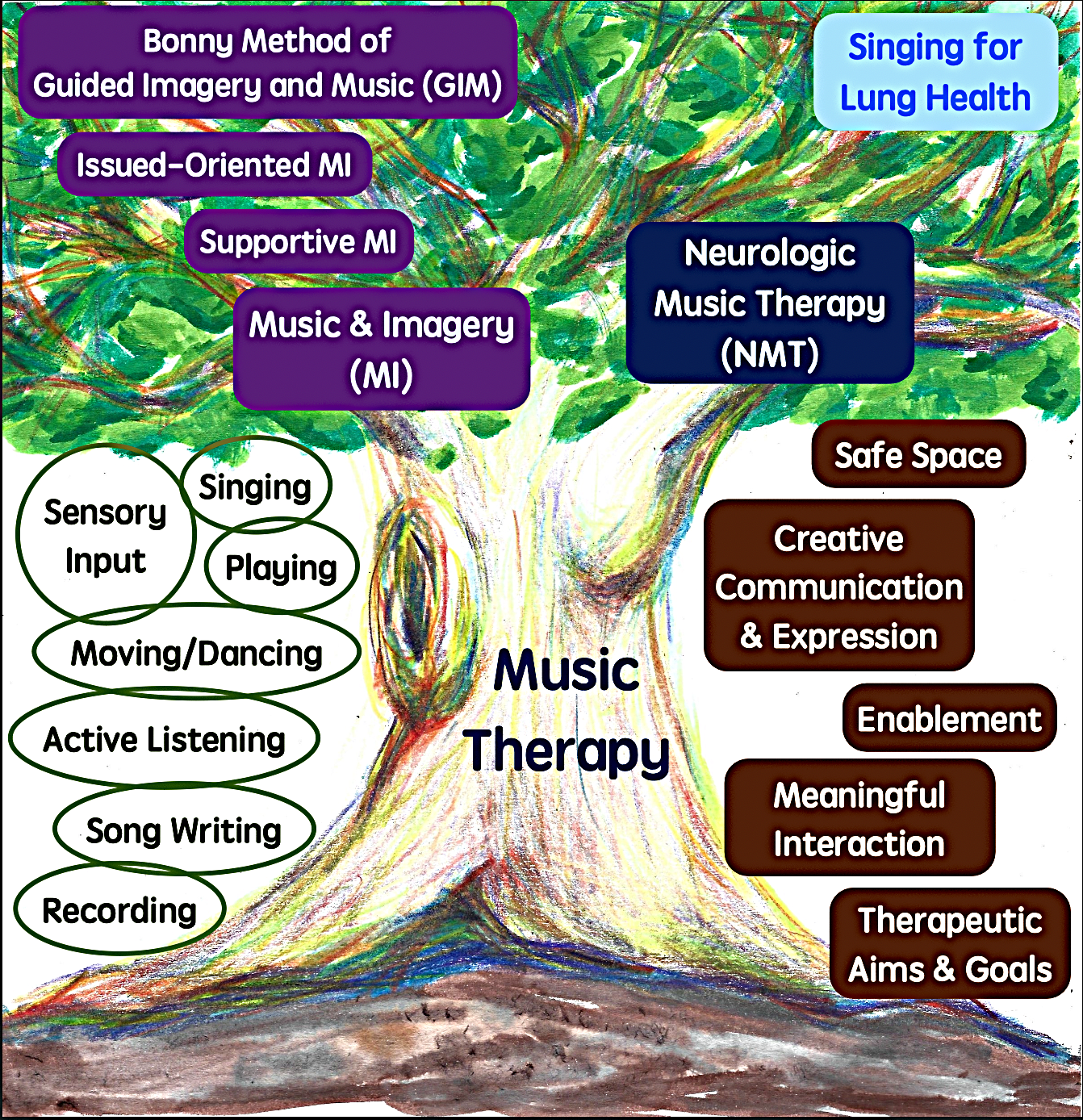
Music Therapy Tree (by Esther Chuang, 2024)
“Music Therapy is an established psychological clinical intervention, which is delivered by HCPC registered music therapists to help people whose lives have been affected by injury, illness or disability through supporting their psychological, emotional, cognitive, physical, communicative and social needs.”
– British Association For Music Therapy –
Music is an essential element in every culture, and it plays an important role in our daily lives. Music is an universal behaviour for all human beings, and it can be seen as a more fundamental form of communication and self-expression.
We listen to music, sing, and dance to tunes on the radio. We all use music to connect to others and express our emotions. Music can help us relax, make us feel safe, and enhance our wellbeing.
Music therapy is centred on a therapeutic relationship, which is established and developed between a therapist and a client. Through engagement in live musical interaction and play between the therapist and client, the therapist uses music interventions to support the client’s needs and helps them to accomplish individualised goals.
Music therapists are trained to work with people of all ages. In music therapy, music improvisation is the main tool for communication but precomposed music and other forms of communication may also be used. Previous musical experience or training is not necessary to take part in music therapy.
There are various approaches in the field of music therapy, just as there are many branches on a tree. Like the illustration above (Music Therapy Tree by Esther Chuang 2024), there are different branches of Neurologic Music Therapy and Music & Imagery on the music therapy tree, for example. And, on the branch of Music and Imagery, there are different types (or levels) of sessions such as Supportive Music and Imagery, Issued-Oriented Music and Imagery, and Bonnie Method of Guided Music and Imagery (GIM). These MI sessions work with different levels of consciousness. Therefore, to complete a certain level of training and qualification is required to enable a healthcare practitioner to deliver and practise any MI sessions.
Below are some examples of conditions that can be addressed through music therapy:
- Alzheimer’s Disease
- Autism
- Brain injuries
- Dementia
- Depression and/or anxiety disorder
- Eating disorder
- Emotional and behavioural needs/difficulties
- Learning disabilities
- Mental health
- Neuro disabilities
- Parkinson’s disease
- Physical disabilities
- Terminal illness
- Trauma
Here are more information on Neurologic Music Therapy (NMT) and Music & Imagery (MI).
————————————————————————————–
More information and resources about music therapy can be found on the British Association For Music Therapy website (https://www.bamt.org/).
 Astar Music Therapy | Scotland